ADDIE vs. SAM: Choosing the Right Approach for Corporate eLearning
Corporate training projects rarely follow a single, clean path.
Timelines shift, stakeholders evolve, and requirements are often clearer in hindsight than at the start. That’s why instructional design models like ADDIE and SAM are most useful when treated as tools, not rules.
Both offer structure. The difference is in how that structure adapts to real-world conditions.
Understanding ADDIE in Practice
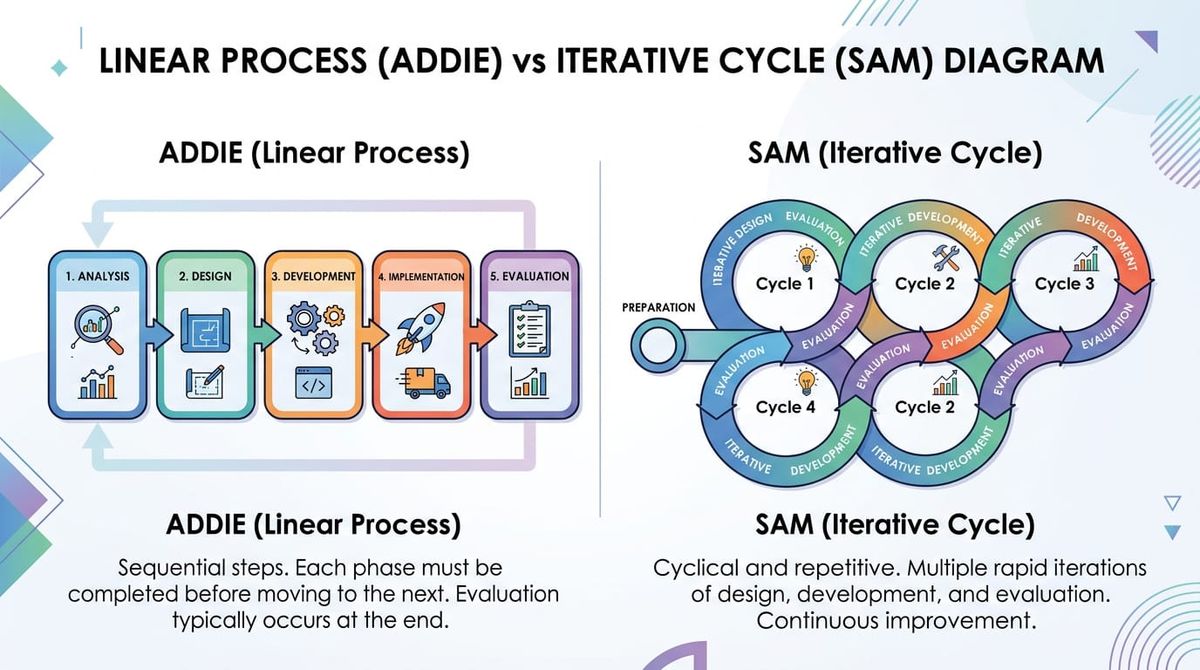
ADDIE—Analyze, Design, Develop, Implement, Evaluate—is often seen as the standard approach to instructional design.
In regulated or high-stakes environments, that structure matters.
- Analysis ensures requirements are clear before development begins
- Design and Development follow a defined path
- Implementation and Evaluation confirm the training meets its objectives
In environments like pharmaceutical or technical training, this level of rigor helps ensure accuracy, consistency, and compliance.
ADDIE works best when:
- Requirements are well-defined
- Content must be precise and validated
- Changes are costly or limited
It creates stability in environments where there is little room for error.
Where SAM Changes the Dynamic
SAM—the Successive Approximation Model—takes a different approach.
Instead of moving linearly, SAM emphasizes rapid iteration:
- Build quickly
- Test early
- Refine continuously
This allows stakeholders to react to something tangible rather than abstract plans.
In practice, this might look like:
- Early prototypes of a module
- Quick feedback loops with subject matter experts
- Iterative improvements before full development
SAM works best when:
- Requirements are evolving
- Stakeholder input is critical
- Speed and flexibility are priorities
It reduces the risk of building the “right thing” too late.
Choosing the Right Approach
In most corporate environments, the answer isn’t ADDIE or SAM.
It’s knowing when to use each.
A project might begin with:
- ADDIE-style analysis to establish clarity and scope
Then shift into:
- SAM-style iteration to refine the experience
This hybrid approach allows for both:
- structure where it’s needed
- flexibility where it adds value
Designing for Reality
Instructional design frameworks are most useful when they reflect how work actually happens.
Projects don’t unfold in perfect phases. They evolve through collaboration, feedback, and adjustment.
The goal isn’t to follow a model perfectly.
It’s to design learning experiences that are:
- accurate
- adaptable
- effective in real-world environments
A Practical Lens
ADDIE and SAM are often presented as competing approaches.
In practice, they’re complementary.
One provides structure.
The other provides movement.
Effective training design requires both.