Good Training Reduces Anxiety Before It Builds Skill
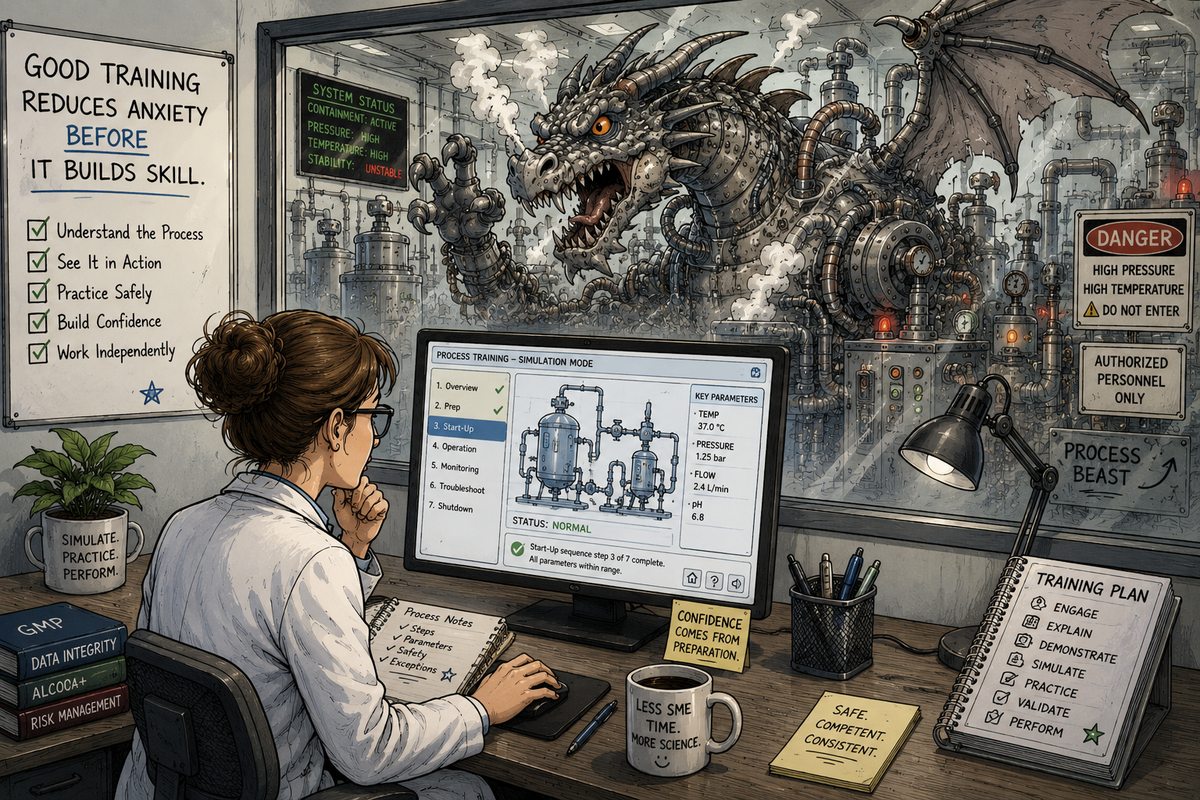
Most process-based training focuses heavily on information transfer. Procedures. Steps. Documentation. Compliance requirements. What often gets overlooked is the emotional state of the learner standing in front of the equipment for the first time.
And in technical environments, that emotional state matters.
Whether it’s laboratory instrumentation, manufacturing systems, specialized software, or process equipment, learners are often navigating more than just complexity. They’re navigating uncertainty. The fear of making mistakes. The pressure of slowing down a team member. The concern that one missed step could affect quality, safety, or production.
Before skill can develop, anxiety has to decrease.
That doesn’t mean training should eliminate challenge. Technical work is challenging by nature. But effective training creates a controlled environment where learners can begin building familiarity before interacting with live systems.
When people understand what they’re looking at, what the workflow looks like, and why steps matter, the equipment stops feeling unpredictable. The process becomes approachable. Confidence starts replacing hesitation.
This is where thoughtfully designed multimedia training can make a measurable difference.
Animations, simulations, guided demonstrations, and scenario-based learning support experiential and adult learning principles by allowing learners to rehearse mentally before they perform physically. This reduces cognitive overload while helping learners build familiarity, confidence, and procedural understanding in a lower-pressure environment. Instead of relying exclusively on SME shadowing or dense documentation, learners can engage with a process repeatedly and at their own pace.
The result is often:
- faster operational readiness
- reduced dependency on SMEs
- more consistent process execution
- stronger retention
- improved safety and compliance confidence
In regulated and technical environments, training is sometimes treated as a documentation exercise. A box to check before someone is cleared to operate independently.
But effective training does more than verify exposure to information.
It reduces cognitive overload.
It creates clarity.
It builds procedural confidence before real-world pressure enters the equation.
Good training doesn’t tame the beast completely.
It simply makes the learner feel ready to approach it.
Explore additional instructional design and multimedia training work at Q Optix.
Explore additional instructional design and multimedia training work at Q Optix.